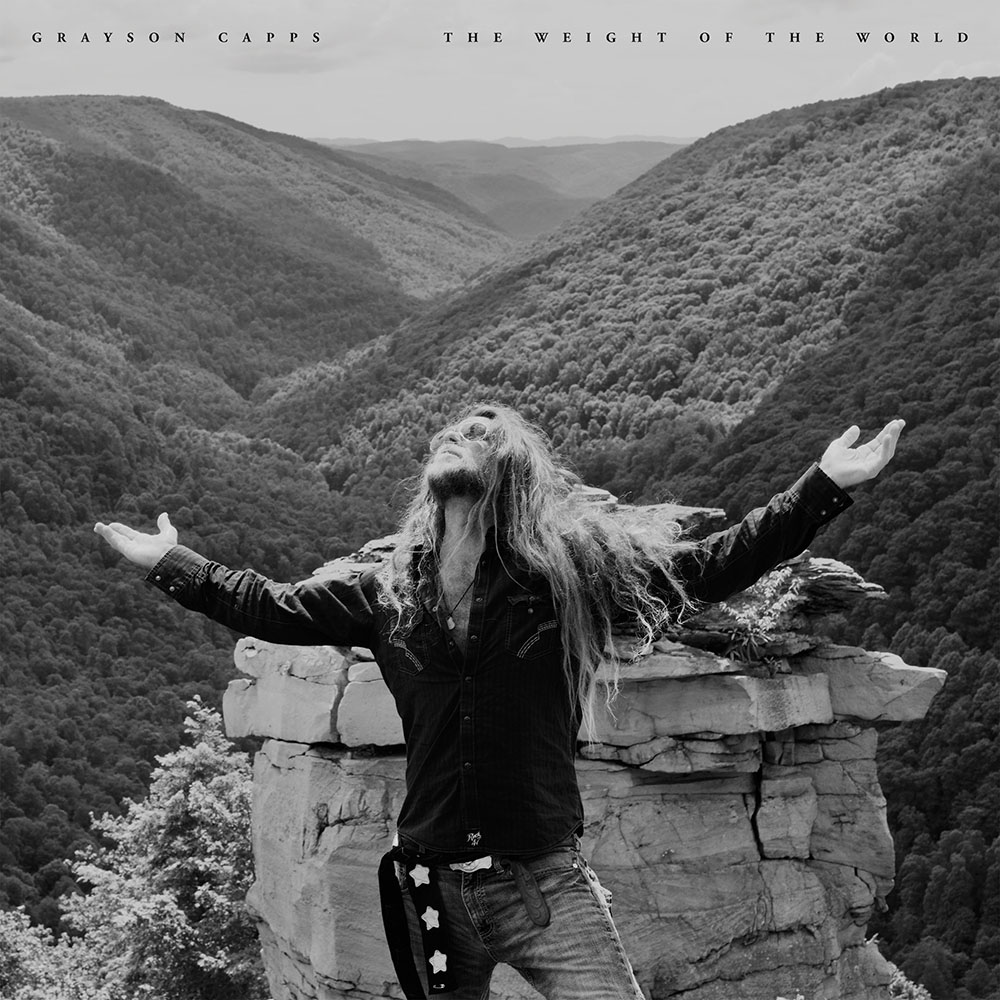
Grayson Capps - Wail and Ride
Bio of Grayson Capps

I was conceived in the back seat of a Pontiac Tempest in Brewton, Alabama, and I first saw the light of a delivery room in Opelika, Alabama the morning of April 17, 1967. This was the year Woody Guthrie and Otis Redding died and the year of the summer of love. My daddy had just gotten out of the Army and was preaching at a Baptist church in Augusta, Georgia, and my mama was a student at Auburn University. The reason I wasn't born in Auburn was because Auburn, Alabama didn't have a hospital at that time. When they found out about me they got married, and daddy quit the church and became a student, too. They both got certified to teach and we moved back to Brewton after they graduated.

The sixties hit Alabama in the seventies and left poignant memories in my brain. The weekends are what stick with me the most. There was an array of eccentrics, channeling Cannery Row or Greenwich Village, in and out of my life at this time. They were writers, painters, musicians, vagrants and ne'er do wells reciting poetry, philosophising, singing, dancing and drinking. I remember a man named Fred Stokes used to come by with his old beat up Martin guitar, and he and a man named Bobby Long and my daddy would sit in front of a Realistic tape recorder drinking and smoking and singing, trying to get a perfect recording, in three part harmony of Glen Campbell's hit Break My Mind, or a number of other songs, without laughing before the end. Fred had a beautiful baritone voice that melded with the strings of that old guitar, Bobby had a high almost pretty voice, and my daddy had a full mid-ranged voice. Then out of nowhere Bobby would stand up and recite the Love Song of J. Alfred Proofrock, or something, accentuate the ending with his glass of vodka and orange juice and sit back down. The entertainement was theatre, 'life is a cabaret.'

We moved to Fairhope, Alabama when I was in about the seventh grade. There I got involved with theatre,literally, and earned a partial scholarship to Tulane University in New Orleans, La. At Tulane I majored in theatre studying primarily acting and graduated in1989 with a BFA. While studying in New Orleans, I started playing guitar with bass player-grad student Pete Ficht and drummer-fellow acting student Sterling Roig. We started a band called the House Levellers, and we called our music 'thrash-folk.' Within a year after we graduated, we got signed by Tipitina's record label in New Orleans. We bought a 1977 Plymouth Voyager van and toured America for three years non-stop. We were on the cover of USA Today, we were in Sassy Magazine, we were opening up for Crowded House, we were becoming famous. Most of the time we slept on people's floors or in the van, barely able to afford gas to get to the next gig. We were theatre majors acting like musicians. Tensions arose from too much junk food, too much time on the road and climaxed in a huge blowout in Charleston, West Virginia, I quit. I was twenty-two going on fifty.

Some friends of mine, John Lawrence and John Dawson, discovered a stretch of houses on the railroad tracks off Tchoupitoulas St. in New Orleans. The street was called S. Front St., but it was my Cannery Row incarnate. A man named Allen Crane was the landlord. He was a one-legged man who drove a rusted out stationwagon, who went bankrupt and died soon after we moved in. There were two shotgun doubles next to one another that he owned. After his death no one claimed the buildings, so we stayed there rent free for a couple of years. We played music on the streets for food and ran extension cords to Dawson's shotgun for electricity. We tapped illegally into the water main to have running water. I had illegal gas, so we cooked at my house, and John Lawrence had a wood burning stove for heat in the wintertime. It would glow red and you could light cigarettes off of it. Most nights I could hear Lawrence practicing his guitar and it sounded so nice. I was writing songs, so we started a band Stavin' Chain.

In Stavin'Chain, I was the singer-rhythm guitar player, and John Lawrence was the lead guitar player. We hired rhythm sections. The music was slide driven roots rock, and the lyrics centered around characters full of desperation, nicotine, loneliness and alcohol. One night after a show at the Maple Leaf Bar, two young women introduced themselves to us; Shainee Gabel and Kristin Hahn. They were filming a documentary called Anthem and wanted us to provide music for them, saying that we embodied an honest form of Americana they wanted portrayed in their film. They used five of our songs in Anthem. We went to L.A. and New York to promote the movie's debut. Around the same time, we were opening for bands like the Wallflowers, Koko Taylor, and Jeff Buckley. One evening at Tipitina's while the Rolling Stones were in town, Ron Wood sat in with us for a twenty minute version of Hideaway while Mick Jagger sat at the bar drinking water. Success was sneaking up like cigarette smoke from an ashtray. We got signed to Ruf Records out of Germany, put out a CD distributed by Polygram Records. Our rhythm section had played on the Stones' record Bridges to Babylon, and in Keith Richards band the Ex-pensive Winos. We had international distribution and a full page ad in the Village Voice. We toured the U.S. and Europe and just as success seemed inevitable, Polygram merged with Universal and dropped our record along with many others across the country. Wall of Sound magazine called our record 'the best 1999 album you never heard of.' Our record label bankrupt, my girlfriend pregnant, and S. Front St. far away, the world and reality check 101 were closing in like an old tube TV turning off. I can hear Dawson saying, 'feed me!' The band broke up.

I remember asking Shainee what she was going to do after Anthem played itself out. She said she wanted to write and direct a film based in New Orleans. I told her about a book my daddy wrote (which is based on Bobby Long and Fred Stokes) that had never been published and takes place in New Orleans, and I gave it to her. She fell in love with the story and wrote a screen play based on it. I remember her saying if it ever came to fruition in a film she would want me to help with the music. This was 1997-98 or so. This past June 2003 she calls and says the movie is being filmed in New Orleans in July and wants me to be in the movie. She said that John Travolta is playing Bobby Long and Scarlet Johanson is playing the girl.

A Love Song For Bobby Long was filmed from late July through August and I am in the movie. I taught John Travolta songs I remember Fred Stokes singing with Bobby Long and my daddy. The film is named after a song I wrote in defense of Bobby called A Love Song For Bobby Long and will be out in the summer or fall of 2004. I have six songs in the movie. The set for the film was a recreation of South Front St.

I write songs which have the voice of dead prophets masquerading as town drunks screaming 'look at us we're pretty, too!' I've been playing guitar and singing for nearly twenty years now. I've played theaters, festivals, radio shows, t.v. shows, whiskey-beer crusted barrooms, living rooms, and camp fires. Some people call me a preacher others a poet, a singer, a guitar player, a landscaper, but I am only an actor strutting and fretting across the stage. I still have to use a shovel. I still have to dig in the dirt. But, I tell you what, I have a beautiful daughter named Sadie, a house on Music St., and my first solo record coming out in the spring. Bobby and Fred are dead, but my father is alive and well in Alabama about to have a novel published. No one knows what tomorrow will bring, but songs are still sung by those who continue to sing.

Can't be satisfied- Muddy Waters
Evil-Howlin' Wolf
Dust my Broom-Elmore James
Ghost riders in the sky- Vaughan Monroe
Angel from Montgomery- John Prine
Sixteen tons- Merle Travis
St. James Infirmary- traditional
Guilty- Randy Newman
Ramblin' Man- Hank Williams
Preachin' blues- Son House
Ain't no tellin- Mississippi John Hurt
Little red rooster- Howlin' Wolf
Hallelujah- Leonard Cohen
Loaded gun- Reveren Horton Heat
Fishin' blues- Taj Mahal
Ring of Fire- Johnny Cash
Columbus Stackade- trad.
Windy and warm- trad.
James Alley Blues- Rabbit Brown
Guitar Rag- Sylvester Weaver
Deep River Blues- Delmore Brothers
Champagne and reefer- Muddy Waters
Lamp trimmed and burnin'- Mississippi Fred McDowell
Give me back my wig- Hound Dog Taylor
Ol' Black Mattie- R.L. Burnside
God don't never change- Blind Willie Johnson
Barbara Allen- trd.
Travelling Riverside blues- Robert Johnson
Yesterday is here- Tom Waits